
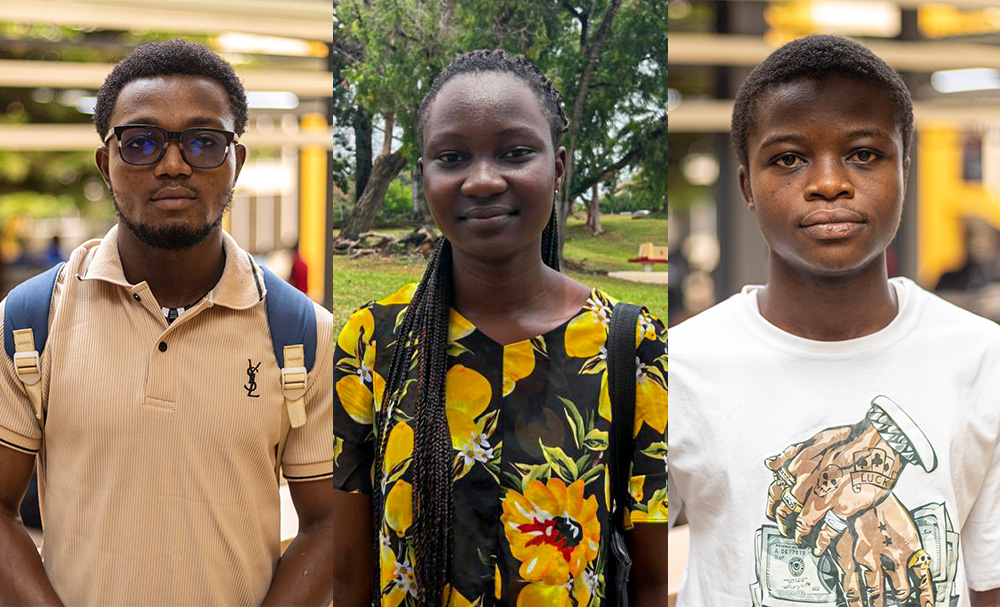
From last-minute anxiety to post-exam debates, students at the Kwame Nkrumah University of Science and Technology, Kumasi (KNUST), navigate a cycle of emotions that defines the experience of examination week.
Minutes before the start of an examination at KNUST, silence and tension fill the air. Hours later, those same spaces give way to animated debates and second-guessing, capturing the emotional highs and lows that define exam week.
Between these two moments lies a journey many students know all too well.
Despite days of preparation, doubt often creeps in at the final moment, especially for first-year students experiencing university examinations for the first time.
“I was feeling so scared because this was my first proper exam. I was just praying that I would be able to answer the questions well,” said Mensah Serwaa Alice, a year one Human Nutrition student.
For others, the pressure begins days before the exam.
Ernest Kofi Danso, a year one Biological Sciences student, described the build-up as intense and demanding. “We started preparing about a week earlier, gathering slides and past questions,” he said. “But even with that, the day before the exam was stressful. It felt like there was still so much to cover in a short time.”
Similarly, Nana Kofi Boateng, a year one Human Biology student, attempted to revise a large volume of material within a limited period.
“I wanted to go through about 700 slides within a week,” he said. “The past questions helped, but during the exam, the format changed. It was more application-based, so it wasn’t exactly what we expected.”
From Panic to Focus
Once students enter the examination hall, the anxiety begins to settle.
Inside, the atmosphere shifts to intense concentration. The initial panic gradually gives way to focus as students engage with the questions in front of them.
“For my first paper, I panicked at the beginning, but as I continued, I became calmer,” said Frimpong Theophilus Kojo, a year three Biochemistry student.
Others found that while the questions were manageable, time pressure remained a challenge.
“When I started, I realised the questions were not too difficult, but they were many,” said Awuni Sadat Nsoh, a year three Biochemistry student. “I just focused on doing what I could within the time.”
Despite the challenges, some students emerged from the examination hall with a sense of relief and accomplishment.
“After the exam, I was happy because some of what I learned came,” Mensah Serwaa Alice added. “Even though some questions were tricky, I did my best and finished on time.”
After the Paper: Relief or Regret?
As students exit the halls, discussions quickly erupt. Answers are compared, questions are analysed, and confidence is sometimes replaced with doubt. Even the “Mecca Road” on their way back to the respective halls comes alive with conversations about what went well and what did not.
For some, these conversations are helpful.
“I discussed the questions with my friends, and it helped me realise what I got right and where I need to improve,” said Awuni Sadat Nsoh.
For others, avoiding post-exam discussions is a deliberate choice.
“I don’t like discussing questions after exams. I prefer to relax, listen to music, and prepare for the next paper,” Nana Kofi Boateng said.
Ernest Kofi Danso shares a similar approach. “After the exam, I didn’t discuss anything. I just went back to my hall, relaxed, and cleared my mind,” he said.
Frimpong Theophilus Kojo also prefers to stay out of such conversations. “Even if the paper goes well, I don’t discuss it,” he said. “I just move on and focus on what is next.”
Coping Between Papers
As examinations continue, students adopt different coping strategies between papers, including resting, listening to music or revising ahead of upcoming exams. For many, the ability to reset quickly becomes essential.
Across campus, the cycle remains the same: anxiety before the paper, focus during, and reflection after.
It is within this rhythm that the true experience of exam week unfolds, not just as a test of academic ability, but as a measure of resilience, composure and adaptability.
At KNUST, beyond the scripts and scores, exam week tells a deeper story, one of determination, shared struggle and the emotional strength required to push through, one paper at a time.
Story: Abigail Ofori Photos: Isaac Kwaku Duah


